
What Is Photobiomodulation and Why NASA Has Been Studying It for Decades
Light as medicine is not a new idea.
Phototherapy, the therapeutic use of light, has been studied and documented since the 1950s. What has changed dramatically in recent decades is our ability to deliver specific wavelengths of light with precision, and our understanding of exactly what those wavelengths are doing at the cellular level.
The result is photobiomodulation, one of the most extensively researched modalities in integrative wellness, and one of the most versatile technologies we offer at Hamptons BioMed.
How it works
Photobiomodulation, often abbreviated as PBM, uses specific wavelengths of light, primarily red and near- infrared, to interact with biological tissue. The mechanism is not thermal. The light is not heating the tissue. It is being absorbed by specific molecules within the cells themselves.
The primary target is cytochrome c oxidase, an enzyme within the mitochondria that plays a central role in cellular energy production. When red and near-infrared light is absorbed by cytochrome c oxidase, it accelerates the electron transport chain, increasing the production of ATP, the molecule cells use as fuel. More ATP means more energy available for cellular repair, immune function, tissue regeneration, and every other energy-dependent process the body carries out.
Light at these wavelengths also dilates small blood and lymphatic vessels, improving local circulation and supporting the clearance of inflammatory byproducts. It stimulates immune and nervous system activity and triggers the release of nitric oxide, which plays important roles in circulation, cellular signaling, and inflammation modulation.
Why NASA got involved
NASA-funded research in the 1990s and early 2000s confirmed what earlier studies had suggested: specific wavelengths of light have measurable effects on cell growth and recovery. NASA's initial interest was practical. In microgravity, wounds heal more slowly and cellular repair is impaired. Photobiomodulation was studied as a way to support the health of astronauts on long-duration missions.
The findings from those studies contributed significantly to the broader understanding of how light affects cellular biology, and they helped establish the scientific credibility of photobiomodulation as a therapeutic modality.
What Firefly does differently
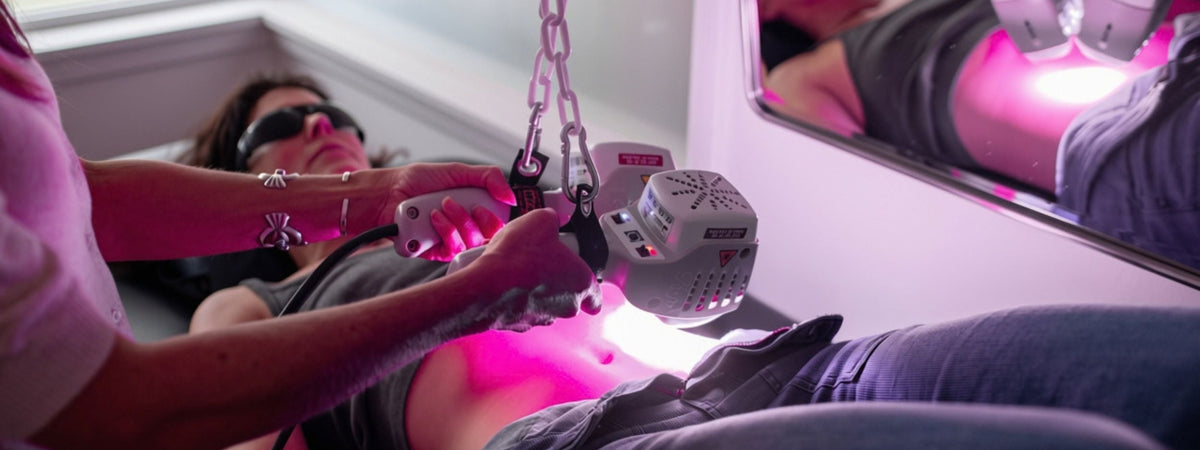
The Firefly system we use at Hamptons BioMed is a multi-spectrum LED device developed by Bales Photonics that delivers pulses of blue, red, and near-infrared light with up to 15 times the power of standard LED systems. It penetrates up to eight inches into tissue, reaching not just the skin but deep tissue, organs, the lymphatic system, and the nervous system.
This depth and power make Firefly one of the most clinically comprehensive photobiomodulation systems available. It is not a surface-level light therapy. It is a systemic one.
What Firefly may support includes mitochondrial function and cellular energy, immune modulation, inflammation reduction, neurological conditions and cognitive support, gut health, pathogen and chronic infection support, and accelerated healing and pain relief.
The consistency of the evidence
One of the most notable things about photobiomodulation research is its breadth. There are thousands of published studies across a wide range of conditions and applications. The mechanisms are well described and consistently observed. This is not an emerging or speculative therapy. It is one of the most studied modalities in non-pharmacological medicine.


